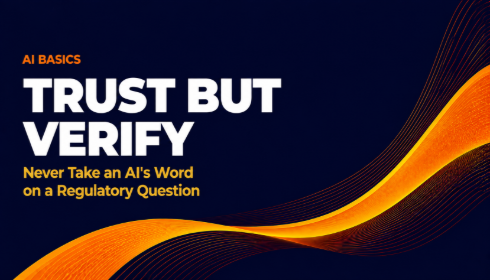
Your AI Gave You a Confident Answer. That Doesn't Mean It's Right.
You asked your AI tool a quick compliance question. Maybe it was about NCUA's current rules on member business lending caps. Maybe it was about how to handle a BSA/AML exception. Maybe you just wanted to know whether your new overdraft product needs a specific disclosure.
The AI answered. It sounded authoritative. It cited the right acronyms. It even referenced what looked like a real regulation.
Here's the problem: it may have made part of that up.
This isn't a knock on AI—it's one of the most important things a credit union executive needs to understand before putting these tools to work. AI language models are not regulatory databases. They are pattern-matching systems trained on text, and when they don't know something precisely, they fill the gap with something that sounds right. That behavior has a name: hallucination. In a regulatory context, it can cost you.
What Is AI Hallucination, and Why Should Credit Unions Care?
Hallucination is when an AI generates information that is plausible-sounding but factually wrong. The model isn't lying. It doesn't know it's wrong. It's doing exactly what it was built to do—predict the most likely next words based on patterns—and sometimes that process produces a confident, well-formatted answer that is simply incorrect.
This happens most often with:
- Specific numbers (dollar thresholds, percentage caps, filing deadlines)
- Recently updated rules (anything revised after the model's training cutoff)
- Niche regulatory guidance (NCUA Letters to Credit Unions, CFPB supervisory highlights, state-level rules)
- Citations (AI will sometimes invent a document title or section number that doesn't exist)
The tricky part isn't that AI gets things wrong. It's that AI gets things wrong confidently. There's no asterisk. No "I'm not sure about this one." Just a clean, professional paragraph that reads like it came from your compliance officer.
AI doesn't know what it doesn't know—and it won't tell you when it's guessing. That's why the human review step isn't optional. It's the whole game.
Why Regulatory Questions Carry More Risk Than Other AI Tasks
Most AI mistakes are low-stakes. A typo in a draft newsletter. A slightly off-tone member communication. You catch it, fix it, move on.
Regulatory mistakes are different. A wrong answer about your CUSO's permissible activities, a misstatement of your field of membership requirements, or a misread of Regulation E's error resolution timeline doesn't just create a rework problem. It can create an examiner finding. A supervisory letter. Potential civil money penalties. Real harm to members.
Your examiners are not going to accept "the AI told us" as a compliance defense. And they shouldn't.
That's not a reason to stop using AI. Many credit union teams use it every day to draft policies, summarize vendor agreements, prep for board meetings, and write member communications—and they do it well. The key is knowing where the guardrails need to go.
How Do You Use AI Safely on Regulatory Topics?
Think of it as three layers of protection. Here's a practical framework your team can actually use.
-
Use AI to frame the question, not answer it. If you're trying to figure out what NCUA says about a specific lending limit, ask the AI to help you identify the right regulation or rule number to look up—then go look it up yourself. Let the AI be your research assistant, not your compliance officer.
-
Treat every specific number as unverified until you check the source. Dollar thresholds, ratio requirements, deadlines, filing windows—any time AI gives you a number in a regulatory context, verify it against NCUA.gov, the CFPB, or your own compliance team before acting. Reg thresholds change just like software pricing does.
-
Build a documented "human in the loop" checkpoint. If your loan ops team uses AI to draft a disclosure, or your marketing team uses it to write a Reg Z-adjacent product description, someone with compliance knowledge needs to review it before it goes anywhere. Document that review step. Your examiners may ask about your process.
-
Know your model's training cutoff. Most large language models have a knowledge cutoff date—anything that changed after that date is invisible to them. NCUA guidance issued six months ago may not exist in your AI's world. Ask the tool directly: "What is your training cutoff?" Then apply extra skepticism to anything time-sensitive. (Verify current model specs; cutoffs change with new releases.)
-
Prompt for uncertainty. You can ask the AI to flag its own confidence level. Try adding this to your prompt: "If you are uncertain about any specific regulatory detail, please say so explicitly." It won't catch everything, but it surfaces gaps you might otherwise miss.
What AI Is Actually Good at in a Compliance Context
None of this means AI has no place in your compliance work. It has a real one—just not as the final word.
Your member services team can use AI to draft plain-language summaries of your existing policies, once a compliance-approved source document is in hand. Board packet prep gets faster when AI condenses a 40-page vendor contract or a dense NCUA Letter to Credit Unions, as long as someone checks the key terms afterward. Training materials, internal FAQs, exam prep checklists—AI can draft all of that from a reliable source and save your team hours.
The pattern is consistent: AI accelerates drafting and summarizing. Humans verify the substance. That division of labor works well. The trouble starts when the verification step gets skipped because the AI sounded so sure.
A Quick Litmus Test Before You Act on an AI-Generated Regulatory Answer
Before you rely on what an AI told you about a regulation, run through these four questions:
- Can I find this specific claim on a primary source—NCUA.gov, CFPB.gov, your state regulator's site, or the actual Code of Federal Regulations?
- Is this rule potentially newer than the model's training cutoff?
- Did the AI cite a specific document or section number? If yes, did I verify that document exists and says what the AI claims?
- Has my compliance team or legal counsel reviewed this before we act?
If you can't answer "yes" to all four, you're not done yet.
Consult your compliance team before acting on any AI-generated regulatory guidance. This post is educational—it is not legal or compliance advice.
What's the risk?
For most AI use cases—drafting member newsletters, summarizing board materials, building internal training content—the risk profile is manageable. A human catches the error before it goes out, and the stakes are low. Compliance and regulatory work is a different category. A hallucinated dollar threshold, a fabricated citation, or an outdated interpretation of Regulation E or BSA/AML requirements can move from an AI output to an examiner finding faster than you'd think. The risk isn't theoretical.
The practical answer isn't to ban AI from anything compliance-adjacent. It's to be clear about the division of labor: AI drafts and summarizes from source material your team provides; a qualified human verifies the substance before anything is acted on or distributed. If your workflow touches member NPI or produces content that could be examined, talk to your compliance team before you build the process, not after. For internal prep work, research framing, and summarizing documents you already trust, the risk is low—go. For anything that becomes a member-facing disclosure, a policy filing, or an examiner-facing document, treat AI output as a first draft that still needs a compliance sign-off.
This post was drafted with AI assistance and reviewed by a human at CU 2.0. AI makes mistakes; verify any specific claim before acting on it.
Frequently Asked Questions
What is AI hallucination and why does it matter for credit unions?
Hallucination is when an AI generates information that sounds accurate but is factually wrong. For credit unions, this is especially risky because a confident-sounding but incorrect answer about NCUA rules, Reg E, BSA/AML requirements, or field of membership could lead to an examiner finding, a supervisory letter, or harm to members.
Can AI tools be used for compliance work at credit unions?
Yes, but with clear guardrails. AI works well for drafting, summarizing, and organizing compliance-related content when a human with compliance knowledge reviews the output before it's used. It should not serve as the final authority on any regulatory question.
Does the AI's training cutoff date matter for regulatory questions?
Yes, significantly. If a rule or guidance document was updated after the model's training cutoff, the AI may give you outdated information without flagging it. Always ask the model when its knowledge ends, and apply extra scrutiny to anything time-sensitive.
Will NCUA examiners accept 'the AI told us' as a compliance explanation?
No. NCUA examiners and other regulators hold credit unions to the same compliance standards regardless of what tools you use internally. AI is not a recognized compliance authority, and relying on it without verification is not a defensible position in an examination.
What's the safest way to prompt an AI when researching a regulatory topic?
Ask the AI to help you identify the right regulation or document to look up, rather than asking it to answer the question outright. You can also add 'flag any details you are uncertain about' to your prompt, then verify the substance through a primary source—NCUA.gov, CFPB.gov, or the Code of Federal Regulations—or your compliance team.
Want to Dig Deeper?
CU 2.0 works with credit union executive teams—at institutions of all sizes—to build practical AI workflows that are fast, useful, and examiner-defensible. Whether you're just getting started with ChatGPT or ready to build custom automations with Claude and n8n, we'll meet you where you are and help you move forward with confidence. Book a call with our team to talk through what AI adoption could look like at your credit union.
This post was drafted with AI assistance and reviewed by a human at CU 2.0. AI makes mistakes; verify any specific claim before acting on it.